
Acreages, shops and garages
Shop, Garage & Pole Barn Insulation in Des Moines, IA
Foam that sticks to steel, stops condensation and makes a heated shop affordable to run.
- Free on-site estimates across the metro
- Written quote listing material, depth and R-value for each area
- Air leaks, damp spots and old wiring checked before anything is covered
Steel Buildings Need a Different Approach
Shop, garage and pole barn insulation is a different job from insulating a house. Around Des Moines, many acreages on the edge of the metro have a steel pole building or shop, and many suburban homes have a detached garage someone wants to heat. Bare steel gets cold, warm air inside condenses on it, and water drips on equipment and floors. Spray foam bonds to the steel, insulates it and keeps humid air off the cold surface, which is why it is the usual answer for these buildings.
Closed cell on steel
Closed-cell foam is the standard choice for metal roofs and walls. It sticks directly to the panels, slows vapor, adds some rigidity, and reaches R-5 to R-7 per inch according to HomeGuide. One to three inches stops drip and makes the building much easier to heat. Open-cell can work in wood-framed shops and garages with a proper vapor plan, but on steel, closed-cell is the safer pick.
How you use the building matters
A cold-storage machine shed only needs enough foam to stop condensation. A shop you heat all winter needs more, especially on the roof. A barndominium or a garage with living space above should be insulated like a house. We ask how you use the building, what you heat it with, and whether you plan to finish the walls, and size the foam to that.
Garages attached to the house
An attached garage shares a wall and often a ceiling with living space. Rooms over garages are some of the coldest in suburban homes. Insulating the garage ceiling and shared wall, and sealing the rim between garage and house, helps the room above. Insulating the garage door and outer walls helps if you work or park in there and want it above freezing.
Winter work
Unheated buildings are the hardest places to spray in a central Iowa winter, when a January night averages about 13.8F at the Des Moines airport. The steel and the foam both need to be within the maker's temperature range for good adhesion, so we heat the building or wait for a milder stretch. Spring and fall are the easiest seasons for this work.
Fire protection and finish
Exposed foam may need an ignition or thermal barrier depending on the building and how it is used. We explain the options before we spray. Get a free estimate
Buildings We Insulate
Outbuildings and garages we work on.
Steel pole buildings
Closed-cell on roof and wall steel to stop drip and hold heat.
Heated shops
Thicker foam on the roof and walls for buildings heated all winter.
Detached garages
Walls, ceilings and doors for garages you want to heat or work in.
Attached garages
Ceiling, shared wall and rim sealed to protect the rooms above and beside.
Barndominiums
Living space in a steel building, insulated like a house.
Barrier coatings
Ignition or thermal barrier where foam stays exposed.
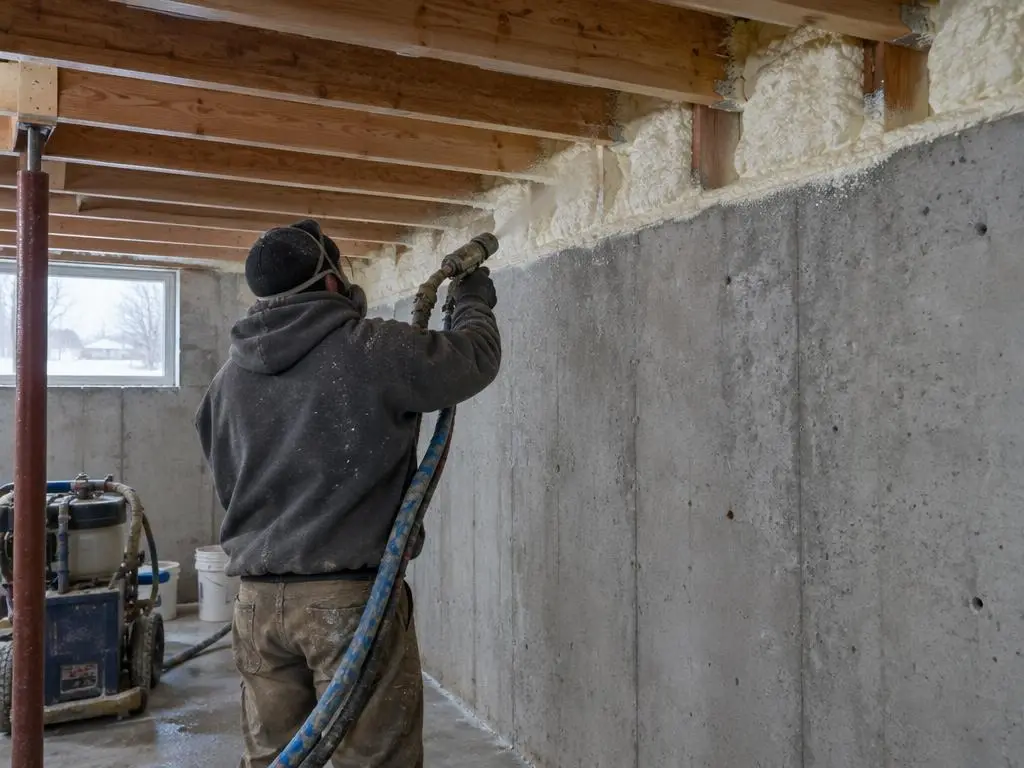
Outbuilding Foam Costs
| Job | Range (source) |
|---|---|
| Closed-cell, installed | $3.00 to $5.00 per sq ft (HomeGuide) |
| Open-cell, installed | $1.50 to $3.50 per sq ft (HomeGuide) |
| New construction spray foam | $2.75 to $6.50 per sq ft (Fixr) |
| About 1,000 sq ft of foam | $1,500 to $5,000 (HomeGuide) |
| Typical minimum charge | $1,000 to $2,000+ (HomeGuide) |
General spray foam ranges from HomeGuide (2026) and Fixr (2025), not specific to outbuildings. Size, steel profile, thickness and coatings change the total; we measure and the written estimate is the price.
How an Outbuilding Job Runs
1. Walk the building
We look at the steel or framing, doors, vents and how the building is used.
2. Size the foam
Thickness is matched to whether the building is cold storage, heated or living space.
3. Prep
Equipment is moved or covered; floors, doors and windows are masked.
4. Spray
Foam goes on steel or framing in passes to the planned thickness.
5. Wrap up
Coatings if needed, cleanup and a walk-through.

Why Choose Us for Shop, Garage & Pole Barn Insulation
Sized to how you use it
Cold storage and heated shops get different plans.
Weather-aware
Cold-weather spraying is planned, not rushed.
Clear barrier advice
You know what the foam needs before we start.
Shop, Garage & Pole Barn Insulation Questions
How thick should foam be in a pole barn?
For stopping condensation in cold storage, about an inch of closed-cell is common. For a heated shop, more on the roof and walls makes sense. We size it to how you use the building.
Can you foam over existing fiberglass blankets?
Usually not. Foam needs to bond to a clean surface, so loose or damaged blankets typically come down first.
Will foam stop my shop from dripping?
Closed-cell foam bonded to the steel keeps warm, damp air off the cold panels, which is what causes the drip.
Can you insulate a garage door?
Yes, with foam or insulated panels, though weatherstripping around it matters too.
Shop, Garage & Pole Barn Insulation Service Areas
- Spray Foam Insulation in Des Moines, IA
- Spray Foam Insulation in West Des Moines, IA
- Spray Foam Insulation in Ankeny, IA
- Spray Foam Insulation in Urbandale, IA
- Spray Foam Insulation in Johnston, IA
- Spray Foam Insulation in Clive, IA
- Spray Foam Insulation in Waukee, IA
- Spray Foam Insulation in Grimes, IA
- Spray Foam Insulation in Windsor Heights, IA
- Spray Foam Insulation in Altoona, IA
- Spray Foam Insulation in Pleasant Hill, IA
- Spray Foam Insulation in Bondurant, IA
- Spray Foam Insulation in Norwalk, IA
- Spray Foam Insulation in Indianola, IA
- Spray Foam Insulation in Adel, IA
- Spray Foam Insulation in Carlisle, IA
Get a Shop, Garage & Pole Barn Insulation Estimate
Tell us about your shop, garage or pole building, and we will set up a visit.