
Open studs or finished walls
Wall Insulation in Des Moines, IA
Foam when the framing is exposed, dense-pack when the drywall or plaster is staying.
- Free on-site estimates across the metro
- Written quote listing material, depth and R-value for each area
- Air leaks, damp spots and old wiring checked before anything is covered
Two Ways Into a Wall
Wall insulation depends on one question: are the walls open or closed? In an addition, a gutted remodel, a garage conversion or a new build, the studs are exposed and spray foam can fill each bay. In a finished Des Moines house with plaster or drywall that is staying, the walls are filled from small holes with dense-pack cellulose or fiberglass. We do both, and we start by finding out what is in your walls now.
The code number
Iowa's Table R402.1.1 lists R-20, or R-13 in the cavity plus R-5 continuous, for wood-frame walls in Climate Zone 5. In a 2x6 wall, open-cell foam or batts can reach R-20. In a 2x4 wall, there is only about three and a half inches of space, and closed-cell foam at R-5 to R-7 per inch (HomeGuide) is one of the few ways to get close. That is why we often recommend closed-cell for additions framed with 2x4s and for walls between the house and an attached garage.
New construction and additions
The metro's newer suburbs are still building: Point2Homes data shows 38.1% of Waukee homes built from 2010 to 2019 and 40.2% of Grimes homes in the same decade. Iowa's code requires new homes to pass a blower door test at 4 air changes per hour or less, and foam in the walls and at the rim helps a house get there. We coordinate with your builder so foam goes in after rough-in inspections and before drywall.
Older houses with empty walls
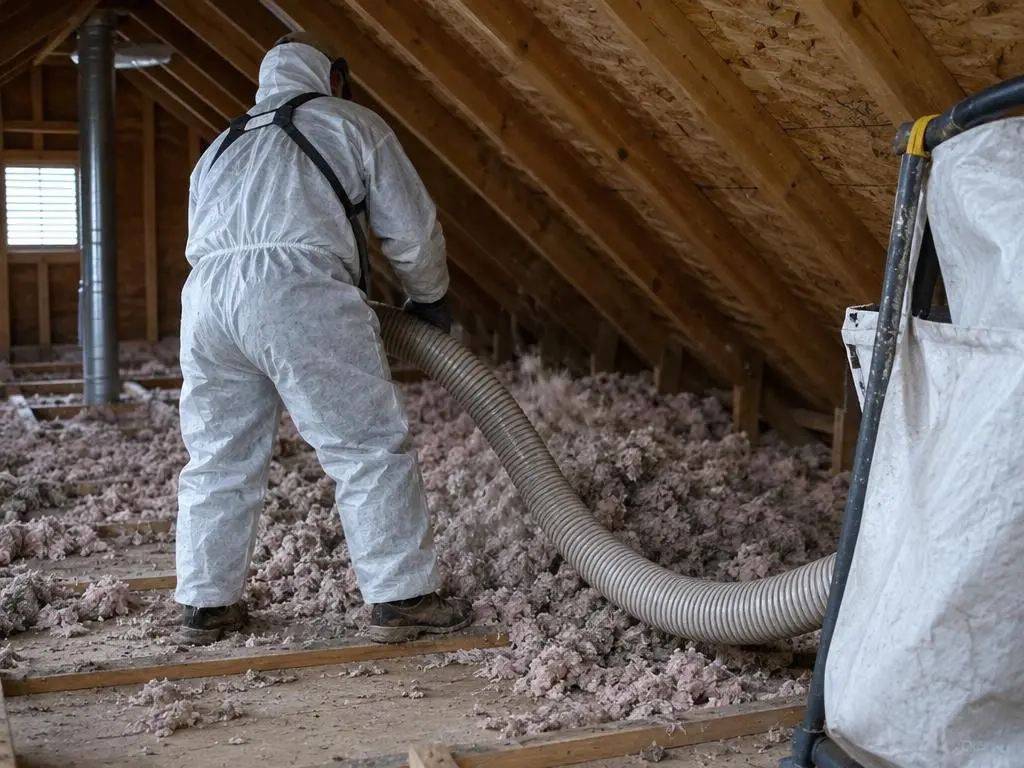
Many pre-war Des Moines houses were built with no wall insulation at all, and some of the walls are open at the top and bottom so air moves through them freely. We check by removing an outlet cover or drilling a small test hole. If the cavities are empty, dense-pack cellulose blown at high density fills them and slows air movement. On older siding, the holes can often be drilled from outside under a lifted course; on plaster, from inside, then patched. Expanding foam is rarely the right choice for closed walls.
Garage and shared walls
Rooms over a garage and walls shared with an attached garage are common complaints in suburban homes. We seal the garage ceiling and the rim between the garage and the house, and insulate the shared wall to the house-side standard.
Sound between rooms
Open-cell foam and dense-pack both cut sound through interior walls and floors, which helps around home offices, bedrooms next to living rooms and basement media rooms. Get a free estimate
Wall Work We Do
Options for open and closed walls.
Closed-cell in 2x4 walls
High R-value in a shallow wall, plus air and vapor control.
Open-cell in 2x6 walls
Fills deep cavities, seals air and quiets sound.
Dense-pack in closed walls
Cellulose or fiberglass blown through small holes into empty cavities.
Garage shared walls
Insulation and sealing between the garage and living space.
Interior sound walls
Foam or dense-pack in walls and floors between rooms.
Builder coordination
Scheduled after rough-in inspection and before drywall.
Wall Insulation Costs
| Job | Range (source) |
|---|---|
| Spray foam, existing walls | $3.15 to $7.50 per sq ft (Fixr) |
| Spray foam, new construction | $2.75 to $6.50 per sq ft (Fixr) |
| Spray foam, all exterior walls | $4,000 to $10,000 (HomeGuide) |
| Blown-in, exterior walls | $1,900 to $7,800, or $1.10 to $3.70 per sq ft (HomeGuide) |
| Dense-pack cellulose | $1.60 to $4.20 per sq ft (HomeGuide) |
| Blown-in walls (Fixr) | $2,000 to $4,000 (Fixr) |
National ranges from Fixr (2025) and HomeGuide (2025 and 2026). Wall height, siding or plaster, access and patching change the total. The written estimate is the number you pay.
How a Wall Job Runs
1. Find out what is there
Test holes or outlet checks show whether cavities are empty, partly filled or blocked.
2. Choose the method
Foam for open studs, dense-pack for closed walls, with the reason written down.
3. Prep
Furniture moved and covered; outlets and windows masked; siding courses lifted if needed.
4. Insulate
Foam is sprayed and trimmed, or each bay is dense-packed to the right density.
5. Patch and clean
Holes are plugged and patched, and we clean up.
Why Choose Us for Wall Insulation
We check the cavity first
No guessing about what is inside the wall.
Right fill for the wall
Foam where the studs are open, dense-pack where they are not.
Builder friendly
We work around inspections and drywall schedules.
Wall Insulation Questions
Can you insulate walls without tearing them out?
Yes. Dense-pack cellulose or fiberglass is blown through small holes, then the holes are plugged and patched.
Is spray foam good for existing walls?
Usually not. Expanding foam in closed walls can leave voids and put pressure on plaster or drywall. Dense-pack is the standard method.
What R-value do walls need in Iowa?
Iowa's code table lists R-20, or R-13 plus R-5 continuous, for wood-frame walls in Zone 5.
When should foam go in on a new build?
After the rough electrical, plumbing and framing inspections and before drywall.
Wall Insulation Service Areas
- Spray Foam Insulation in Des Moines, IA
- Spray Foam Insulation in West Des Moines, IA
- Spray Foam Insulation in Ankeny, IA
- Spray Foam Insulation in Urbandale, IA
- Spray Foam Insulation in Johnston, IA
- Spray Foam Insulation in Clive, IA
- Spray Foam Insulation in Waukee, IA
- Spray Foam Insulation in Grimes, IA
- Spray Foam Insulation in Windsor Heights, IA
- Spray Foam Insulation in Altoona, IA
- Spray Foam Insulation in Pleasant Hill, IA
- Spray Foam Insulation in Bondurant, IA
- Spray Foam Insulation in Norwalk, IA
- Spray Foam Insulation in Indianola, IA
- Spray Foam Insulation in Adel, IA
- Spray Foam Insulation in Carlisle, IA
Get a Wall Insulation Estimate
Building, remodeling or just tired of cold walls? Ask for a written quote.