
Closed-cell and open-cell foam
Spray Foam Insulation in Des Moines, IA
Dense foam where cold and damp meet the house, lighter foam where air sealing and sound matter more.
- Free on-site estimates across the metro
- Written quote listing material, depth and R-value for each area
- Air leaks, damp spots and old wiring checked before anything is covered
One Product, Two Very Different Foams
Spray foam insulation is mixed at the gun, sprayed as a liquid and expands to fill the space before it cures, so one pass both insulates and stops air. That combination is why it suits the cold, leaky spots in a central Iowa house, where a January night averages about 13.8F at the Des Moines airport according to Wikipedia's climate table. We spray two kinds of foam, and choosing between them is the first decision on every job.
Closed cell vs open cell
Closed-cell foam cures hard. HomeGuide rates it at R-5 to R-7 per inch, and at typical thickness it works as a vapor retarder and does not take on water. It also adds stiffness to the wall or deck it is sprayed on. Open-cell foam is soft and expands far more, at about R-3.5 to R-3.7 per inch. It seals air well and deadens sound, but vapor passes through it, so in Climate Zone 5 it needs a vapor retarder or an assembly that can dry.
Around Des Moines that pushes closed-cell toward rim joists, basement walls, roof decks over vaulted ceilings and the steel in shops and pole buildings. Open-cell earns its place in interior walls, between floors, and in attic rooflines where the moisture plan is sound.
Thickness against the code table
Iowa's version of the 2012 IECC lists R-20, or R-13 plus R-5 continuous, for wood-frame walls in Zone 5 and R-49 for ceilings. Closed-cell reaches high values in a few inches, which matters in a 2x4 wall or a shallow rafter bay where batts cannot fit. Under a roof deck with no attic, getting a high R-value while still leaving a vent channel is hard, and closed-cell solves that. We size the thickness to the target and put both numbers on the quote.
Where foam does the most good
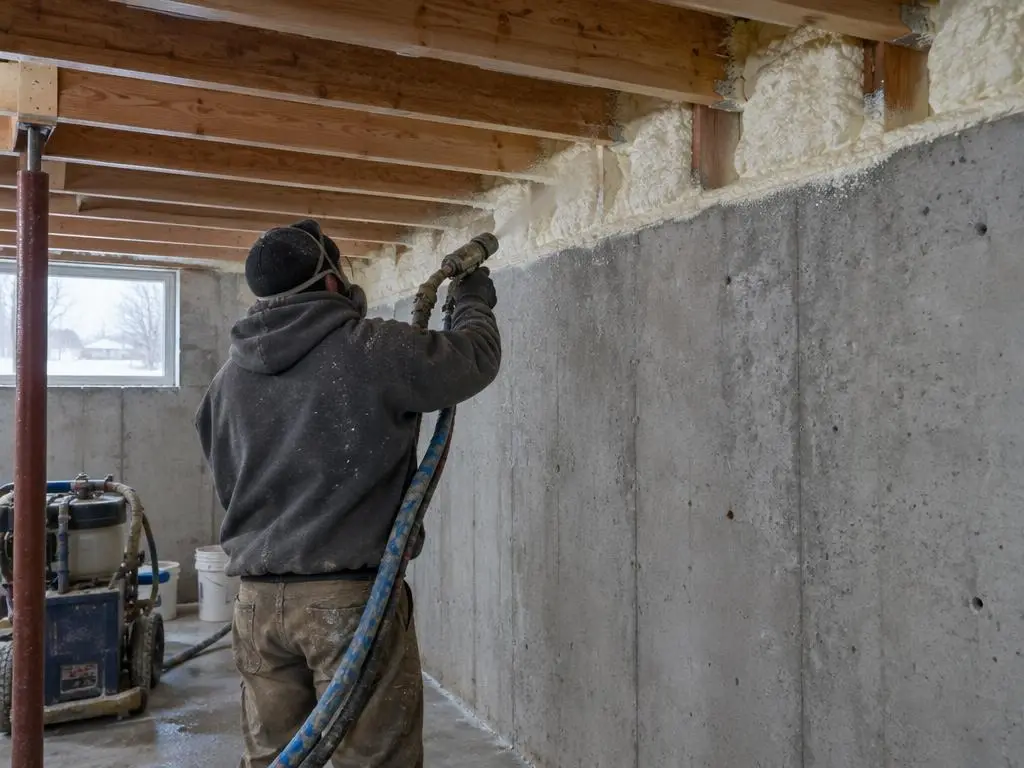
The rim joist is our most common foam job: the band of framing on top of the foundation, which in most metro basements is bare wood or has a loose piece of fiberglass pushed against it. Two to three inches of closed-cell seals and insulates it in one step. Other good spots are kneewalls and the floors behind them in story-and-a-half houses, floors over garages and cantilevers, walls in additions while the studs are open, and cathedral ceilings.
When we say no to foam
Foam does not fix a leak. If a roof, window or plumbing leak is wetting the framing, it gets repaired first, or the foam will hide the rot. Foam should not go over knob-and-tube wiring, or over vermiculite that may contain asbestos, until those are dealt with. And on an open attic floor, sealing the gaps and blowing loose fill on top usually reaches R-49 for less. We tell you which parts of the house are worth foaming and which are not.
Curing and re-entry
Before we spray, we cover floors and belongings, mask windows and outlets, and set up ventilation. HomeGuide advises staying out for 24 hours or more while foam cures. The surface and the material need to be inside the maker's temperature range, so for unheated attics and buildings in winter we bring heat or pick a better day. Once cured, foam does not settle or sag. Get a free estimate
Where Spray Foam Goes
The spots we foam most often and the foam we usually pick for each.
Closed-cell foam
Dense foam at R-5 to R-7 per inch (HomeGuide) for rim joists, foundation walls, roof decks and steel.
Open-cell foam
Lighter foam at R-3.5 to R-3.7 per inch for above-grade cavities with a vapor plan.
Rim joists
Foam on the band above the foundation to stop drafts all the way around the basement.
Kneewalls and rooms over garages
Sealing the walls and floors around upstairs and bonus rooms that never stay warm.
Vaulted ceilings and roof decks
Closed-cell under the deck where there is no attic or no space for a vent channel.
Open walls in additions
Stud bays filled to the wall target while the framing is exposed.
Shops and pole buildings
Foam on steel to insulate and stop condensation from dripping.
Published Spray Foam Costs
| Job | Typical range (source) |
|---|---|
| Spray foam, installed | $1.50 to $5.00 per sq ft (HomeGuide) |
| Open-cell / closed-cell | $1.50 to $3.50 / $3.00 to $5.00 per sq ft (HomeGuide) |
| About 1,000 sq ft | $1,500 to $5,000 (HomeGuide); $3,150 to $7,500 in an existing home (Fixr) |
| Existing walls / new construction | $3.15 to $7.50 / $2.75 to $6.50 per sq ft (Fixr) |
| Attic | $3,000 to $8,000 (HomeGuide) |
| Whole house | $8,000 to $20,000 (HomeGuide); $10,000 to $30,000 (Fixr) |
| Typical minimum charge | $1,000 to $2,000+ (HomeGuide) |
National ranges from HomeGuide (2026) and Fixr (2025). Foam type, thickness, access and prep decide the real figure, and the number on our written estimate is the one you pay.
How a Foam Job Runs
1. Inspect
We check each space for leaks, damp wood, old wiring and vermiculite, and measure.
2. Quote in writing
Each area lists foam type, thickness, target R-value and price.
3. Prep
Floors and belongings get covered, openings masked and ventilation set up; cold spaces get heated.
4. Spray
Foam goes on in passes to the planned thickness and is trimmed where needed.
5. Walk-through
We clean up, show you the finished work and tell you when the space can be used.

Why Choose Us for Spray Foam Insulation
Foam only where it pays
If blown-in or simple sealing does the job for less, we say so.
Numbers on paper
Thickness and R-value are written down so bids can be compared.
Problems flagged early
Leaks, wiring and suspect vermiculite are raised before anything gets covered.
Spray Foam Insulation Questions
Which spray foam has the highest R-value?
Closed-cell, at about R-5 to R-7 per inch according to HomeGuide, compared with R-3.5 to R-3.7 for open-cell.
What are the drawbacks of closed-cell foam?
It costs more per square foot, it is hard to remove later, and it must be installed and cured carefully. On an open attic floor it is usually more than the job needs.
Does spray foam stop moisture?
Closed-cell slows vapor and keeps humid indoor air off cold surfaces where it would condense. It is not waterproofing, so leaks are fixed first.
Who makes spray foam insulation?
Several chemical companies make two-part spray foam systems for contractors. What matters more for you is that the product suits the spot, is applied at the right thickness and temperature, and is allowed to cure fully.
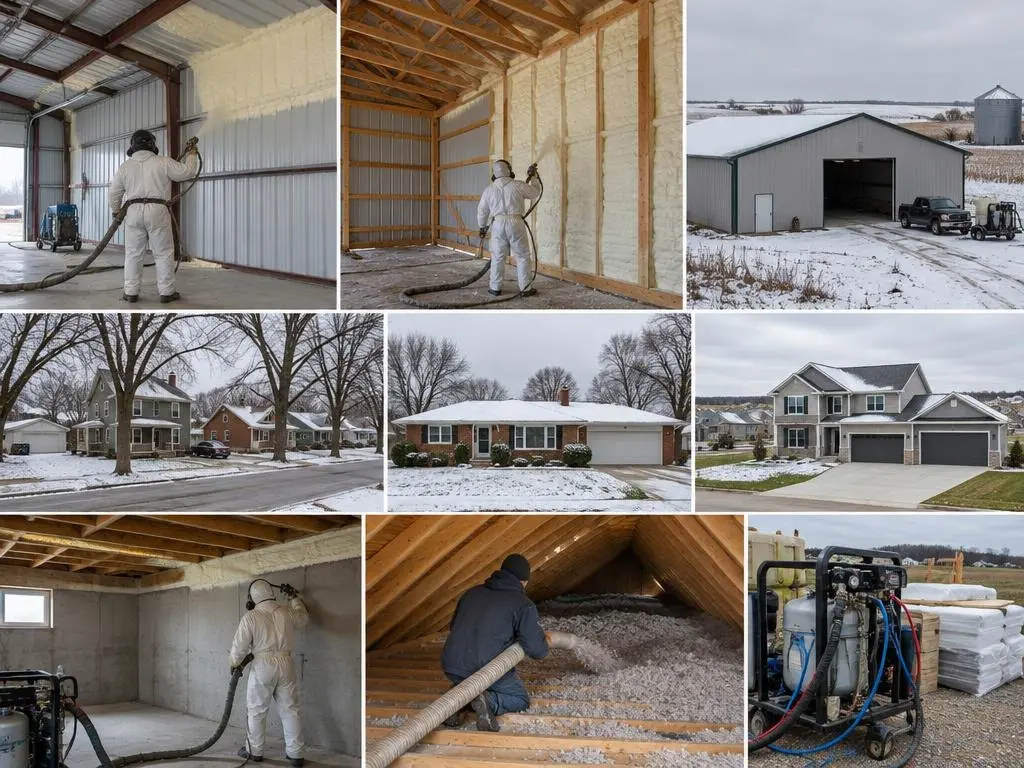
Spray Foam Insulation Service Areas
- Spray Foam Insulation in Des Moines, IA
- Spray Foam Insulation in West Des Moines, IA
- Spray Foam Insulation in Ankeny, IA
- Spray Foam Insulation in Urbandale, IA
- Spray Foam Insulation in Johnston, IA
- Spray Foam Insulation in Clive, IA
- Spray Foam Insulation in Waukee, IA
- Spray Foam Insulation in Grimes, IA
- Spray Foam Insulation in Windsor Heights, IA
- Spray Foam Insulation in Altoona, IA
- Spray Foam Insulation in Pleasant Hill, IA
- Spray Foam Insulation in Bondurant, IA
- Spray Foam Insulation in Norwalk, IA
- Spray Foam Insulation in Indianola, IA
- Spray Foam Insulation in Adel, IA
- Spray Foam Insulation in Carlisle, IA
Get a Spray Foam Insulation Estimate
Tell us which spaces you have in mind. We will look and send a written foam plan and price.